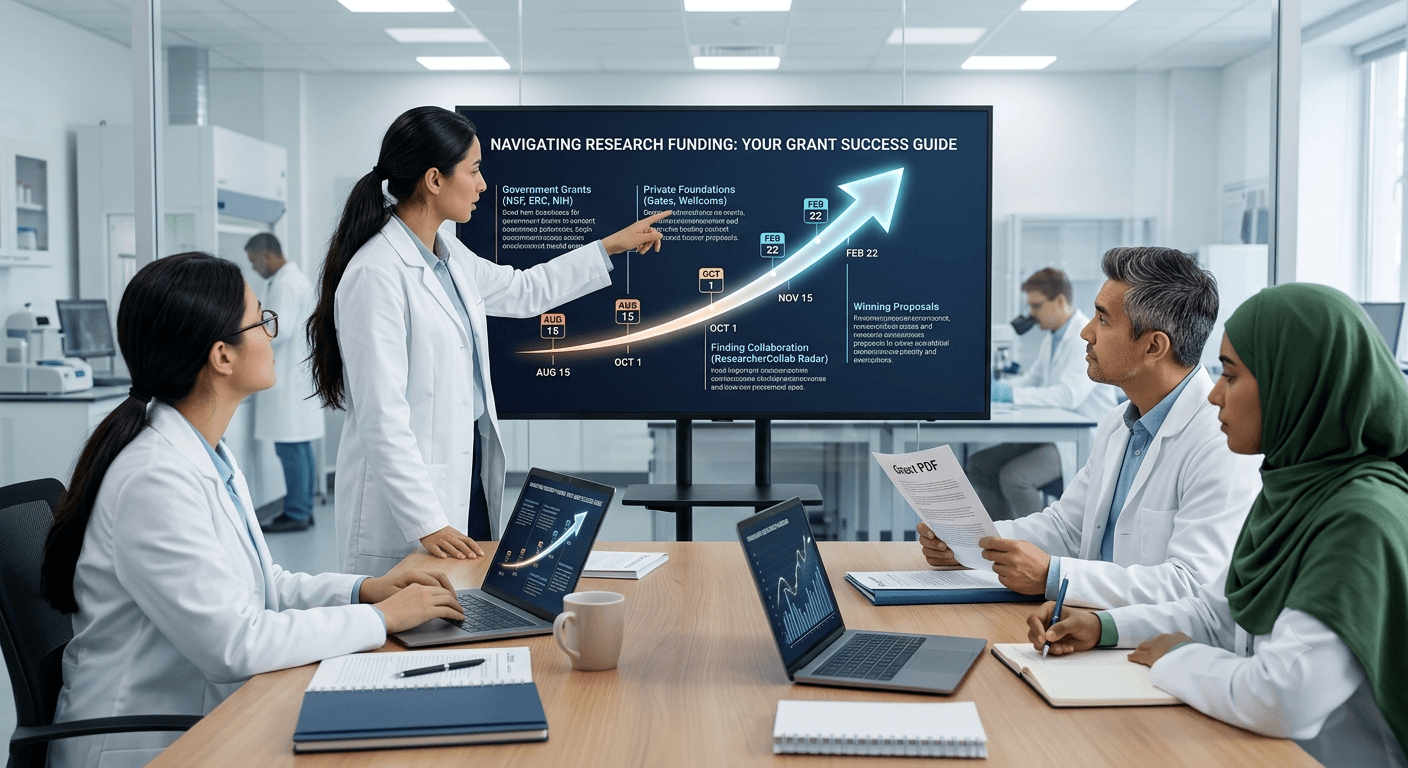
Research funding is one of the most competitive and most confusing parts of an academic career. Deadlines shift, eligibility rules are buried in long PDFs, and the gap between "there must be a grant for this" and actually finding it can take weeks.
This guide covers the main types of research funding, where to find grants in 2026, how to apply step by step, and how to write a proposal with a real chance of being funded.
Why Many Researchers Miss Funding Opportunities
The problem is often not a lack of funding but a lack of visibility. Researchers at well-connected institutions have colleagues and grants officers who track opportunities for them. Researchers at smaller institutions, or early in their careers, often do not.
A few common patterns:
- Focusing on one or two well-known funders and missing foundations and international programmes that fit the work better
- Not reading eligibility criteria carefully, and ruling yourself out of calls you actually qualify for
- Missing deadlines because there is no system for tracking calls across several funders
- Overlooking international and private foundation funding, especially outside the US and Europe
Types of Research Funding
Government grants
Government agencies are the largest source of research funding in most countries. Some of the main ones by region:
- United States: NSF (all fields), NIH (biomedical and health), DOE (energy and physical sciences), NEH (humanities), USDA (agriculture)
- European Union: Horizon Europe, the EU's main research and innovation programme, with a budget of around €95.5 billion for 2021 to 2027. European Research Council (ERC) grants are highly competitive and highly respected.
- United Kingdom: UKRI, which funds research across all disciplines through its research councils (AHRC, BBSRC, EPSRC, ESRC, MRC, NERC, STFC)
- Canada: SSHRC (social sciences and humanities), NSERC (natural sciences and engineering), CIHR (health)
- Australia: the Australian Research Council (ARC) and NHMRC (health)
- India: the Anusandhan National Research Foundation (ANRF), DST, DBT and ICMR (health)
- Pakistan: the Higher Education Commission (HEC) research grant programmes
- Türkiye: TÜBİTAK, including its ARDEB research grant programmes
Most countries have a national research council or science ministry that runs similar programmes. If your country is not listed here, that is the place to start.
Private foundations
Private foundations are often more flexible in scope than government funders, and some specifically look for interdisciplinary or unconventional projects that do not fit neatly into government categories.
Well-known international foundations include the Wellcome Trust (health and biomedical research), the Gates Foundation (global health and development), the Simons Foundation (mathematics, physics and life sciences) and the MacArthur Foundation, along with hundreds of smaller funders focused on a single field or disease.
Foundations are usually mission-driven. Your proposal needs to show how it serves their goals, not only that your science is strong.
Industry and corporate funding
Industry funding can bring resources that public funders cannot, such as data, equipment or access to real-world settings, and the collaboration itself can open career paths. It also comes with real risks: intellectual property terms, publication restrictions and potential bias. Agree on these through your institution's research office before work starts, and always disclose industry funding in your publications.
Institutional and internal grants
Do not overlook your own institution. Seed grants, travel awards, interdisciplinary funds and early career grants are often less competitive simply because fewer people know about them. Your research or grants office is the first place to ask.
Fellowships
Fellowships fund the researcher rather than a specific project. They are especially important for PhD students, postdocs and early career researchers, and they often have their own eligibility rules based on career stage. Examples include Marie Skłodowska-Curie Actions in Europe and many national postdoctoral fellowship schemes.
Where to Find Research Funding Opportunities
Knowing that funding exists is different from finding the right call at the right time. Here is where to look.
Funding portals and databases
- Grants.gov: US federal funding opportunities
- EU Funding & Tenders Portal: Horizon Europe and other EU calls, including a partner search tool for finding consortium members
- UKRI Funding Finder: current UK research council calls
- Research Professional and Pivot-RP: large, subscription-based databases that many universities provide to their staff
- GrantForward: searchable by keyword and eligibility, mainly US-focused
Most of these let you filter by discipline, country eligibility and amount. Set up email alerts for your key terms. This alone catches many calls you would otherwise miss.
Your university's research office
Research development officers exist to help you find and apply for funding. They often have access to subscription databases, know internal deadlines, and can flag calls that match your profile. If you have not introduced yourself to your research office yet, do it this week.
Funding Radar on ResearcherCollab
ResearcherCollab's Funding Radar lists funding calls, conferences and publication calls in your discipline, with their deadlines, so you can see upcoming opportunities in one place. Free accounts see a selection of the latest opportunities, and PRO accounts see the full list.
Your network
Some of the best funding tips come from other researchers: a colleague who just applied to a foundation you have never heard of, or a researcher in a neighbouring field who knows a programme that welcomes interdisciplinary proposals. This is one of the underrated reasons to build your research network early.
How to Apply for a Research Grant: Step by Step
- Check eligibility first. Read who can apply: career stage, nationality or residence, institution type and whether you need a PhD. Do this before you invest any time in writing.
- Read the call and the funder's priorities. Look at what the funder has supported before and use the same language they use to describe their goals.
- Contact the programme officer if there is one. Many will tell you informally whether your idea fits before you write a full proposal.
- Talk to your research office early. They handle budgets, institutional approvals and internal deadlines, which are often weeks before the funder's deadline.
- Build your team. If your project needs expertise you do not have, find a collaborator who fills that gap before you write.
- Write the specific aims first, then the full proposal around them.
- Prepare the budget and supporting documents: CVs, letters of support, data management plan and ethics approvals if needed.
- Get feedback from at least one person outside your team, ideally someone who has been funded by the same body.
- Submit early. Online portals often slow down on deadline day.
How to Write a Grant Proposal That Gets Funded
Many grant proposals fail at the same hurdles. Knowing them in advance saves months of effort.
Start with the funder's goals, not your research
A common mistake is to write the proposal you want to write and then fit the funder's criteria around it. Successful proposals usually work the other way: they start from what the funder is trying to achieve and show how this research serves those goals.
The specific aims are everything
In most funding schemes, the aims or research questions are the first thing reviewers read and the last thing they remember. They should be:
- Concrete: not "explore the role of X" but "determine whether X causes Y in Z"
- Achievable: reviewers look for feasibility, not ambition alone
- Significant: the "so what" should be obvious, ideally in the first paragraph
- Connected: each aim should build on the others rather than read like three separate projects
Show preliminary data
For most competitive grants, preliminary data shows that you can actually do what you propose. Even a small pilot study, a proof-of-concept analysis or a relevant earlier publication strengthens your case.
Answer the "why you" question directly
Reviewers are asking why this team should get this money. Your track record, methodological expertise, or access to a specific population, dataset or field site: whatever makes your team the right one, say it explicitly. Do not assume reviewers will work it out from your CV.
Get outside feedback before you submit
Ask a colleague outside the project, someone who has been funded by the same body, or your research office to read the proposal. Fresh readers catch unclear aims and jargon that make sense to you but not to a mixed review panel.
How Collaboration Strengthens a Grant Application
Many funders, especially for large or international grants, expect teams that combine different expertise, because complex problems rarely fit inside one discipline. A strong team shows reviewers that:
- You have identified the gaps in your approach and filled them
- The research can have impact across more than one field
- The team together has the track record to deliver
If your application has a clear weakness, such as missing clinical expertise, a specific statistical method or access to a dataset in another region, finding a collaborator who fills it before you submit is usually worth the time. Our guide on how to find research collaborators covers where to look.
Managing Deadlines and Multiple Applications
Many grants take six months or more from submission to decision, so most active researchers work on several applications at once, at different stages and for different funders.
- Keep a master document with your core paragraphs (background, methods, significance) and adapt it for each application instead of starting from scratch.
- Track deadlines in a shared calendar with reminders set eight weeks and three weeks before each one.
- Resubmit rejected applications. Many funders allow it, and reviewer comments are some of the most useful feedback you will get.
- Keep the pipeline moving. Do not wait for a decision before starting the next application, if your workload allows it.
Where to Start if You Have No Track Record
Early career researchers face a familiar problem: you need funding to build a track record, and a track record to get funding. Ways out:
- Target schemes designed for early career researchers. Many major funders have at least one, often for researchers within a few years of their PhD.
- Apply for small internal or travel grants first. Every award you win becomes part of your funding record.
- Join a senior colleague's application as a named co-investigator or collaborator to gain experience without leading the grant.
- Apply for fellowships, which fund you as a researcher and judge you against others at a similar career stage.
Frequently Asked Questions
How long does it take to get a research grant?
It varies a lot by funder. Small internal grants can be decided within weeks, while large national or international grants often take six months or more from the deadline to a decision. Plan your applications well ahead of when you need the money.
Can I apply for research funding as a student?
Yes, but usually through specific schemes: student research grants, travel awards, PhD scholarships and fellowships. Many project grants require the lead applicant to hold a PhD and a position at an institution, so check eligibility before you start.
What is the difference between a grant and a fellowship?
A grant usually funds a project: its staff, equipment and running costs. A fellowship funds a person, often covering their salary or stipend so they can carry out their own research programme.
What should I do if my application is rejected?
Read the reviewer comments carefully, ask the programme officer for feedback if possible, and decide whether to revise and resubmit or adapt the proposal for another funder. Rejection is common, even for very good proposals, and many funded projects were rejected at least once.
The Bottom Line
Research funding is findable. Researchers who win grants regularly tend to have a system for finding calls, understand what each funder wants, and treat grant writing as a skill they keep improving.
To keep track of upcoming calls in your field, try ResearcherCollab's Funding Radar. If your application needs a collaborator to fill a gap, browse researchers by discipline or create a free profile so the right people can find you.