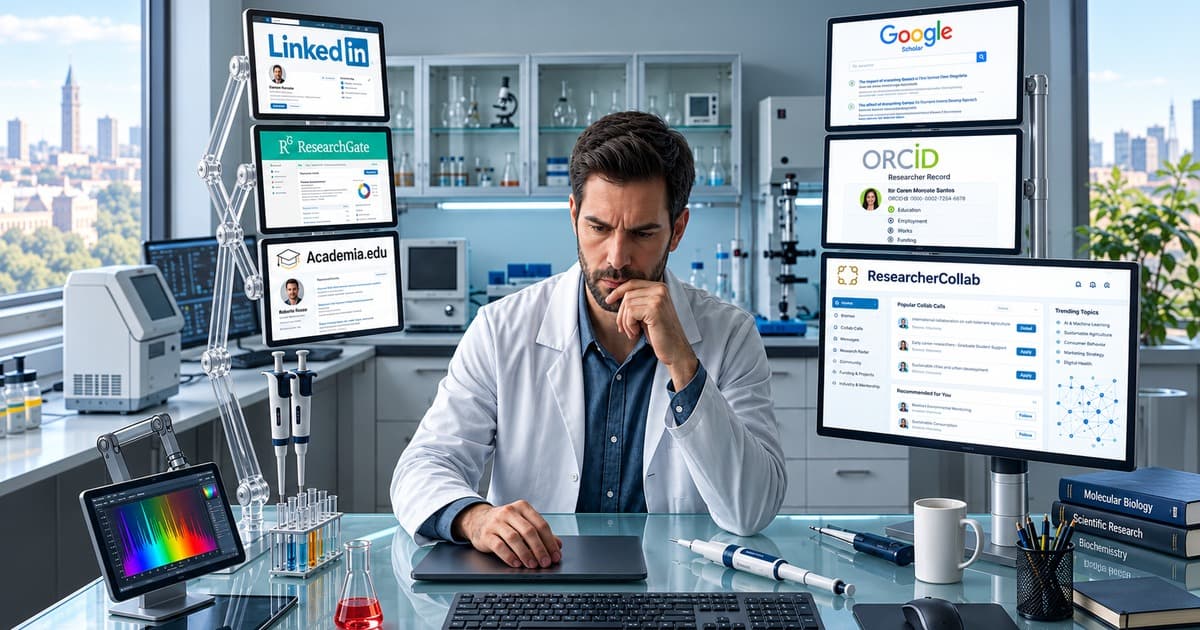
Finding the right research collaborator can be the difference between a stalled project and a strong publication. Yet most researchers rely on the same small circle of colleagues, and miss the people working on the same problem from a different angle, in a different country, or in a neighbouring discipline.
This guide covers where to look for research collaborators, how to reach out so people actually reply, and what makes a research partnership work once it starts.
Why Research Collaboration Matters
Most research questions today need more than one skill set. A clinical question may need a statistician, an environmental study may need someone with field access in another region, and a machine learning project may need a domain expert who understands the data. Working with the right collaborator brings:
- Complementary expertise: methods and knowledge you do not have yourself
- Shared resources: equipment, datasets, lab time and field sites
- Faster progress: the work is split across people who are each good at their part
- Stronger grant applications: many funders ask for multi-institution or international teams
The Problem With Traditional Networking
Most researchers find collaborators the way they always have: conferences, department hallways, and emailing people whose papers they cite. This works, but it is slow, limited by geography, and it favours people who already have strong networks.
If you are an early career researcher, at a smaller institution, or in a field without many established conferences, traditional networking can feel like shouting into a void. The good news is that there are now more ways to find collaborators than ever.
Where to Find Research Collaborators
1. Researcher directories and collaboration platforms
Platforms built for academic collaboration are the most direct starting point, because everyone on them is there to find a collaborator. On ResearcherCollab's researcher directory you can browse researchers by discipline and see their university, country and research interests, then message the ones whose work overlaps with yours.
2. Open collaboration calls
Instead of searching for a partner yourself, you can describe what you need and let the right people come to you. A good collaboration call says what the project is, what expertise you are looking for, and what the collaborator would get out of it (co-authorship, data access, a joint grant). You can browse and post open collab calls by discipline on ResearcherCollab, for example in medicine, computer science or education.
3. The authors you already cite
The people whose papers sit in your reference list are often your best potential collaborators: you already know their work and why it matters to yours. Two quick ways to widen this list:
- On Google Scholar, open a key paper in your field and use Cited by and Related articles to find people actively building on the same work.
- Look at the co-authors of researchers you admire. Groups that publish together often welcome new collaborators with a complementary method.
4. ORCID and ResearchGate
ORCID records list a researcher's publications, affiliations and often their websites, which makes them useful for checking someone's track record before you reach out. ResearchGate is strong for discovery: you can see who works on overlapping topics and who reads or cites your work. Messages there tend to get a low response rate, so it works best for finding people rather than for the first contact.
5. Preprint servers
arXiv, bioRxiv, medRxiv and SSRN show who is working on a problem right now, often months before the work is published. Authors of a recent preprint that complements your work are actively engaged with the topic and are often open to discussing it.
6. Conferences and workshops, including online ones
Conferences are still one of the best places to start a collaboration, because a short conversation builds more trust than any email. If travel is not possible, online conferences, webinars and workshop series in your field are worth attending. Note the names of speakers and people asking good questions, and follow up within a week while the conversation is still fresh.
7. Social media
Many researchers share new papers and open questions on LinkedIn, Bluesky and X. Following researchers in your field and taking part in discussions makes your work visible, and visibility brings collaboration requests to you.
8. Your university's research office
Research offices often know about funding schemes that require partners, international consortia looking for members, and colleagues in other departments working on related questions. It is an underused resource, especially for interdisciplinary projects.
How to Write a Collaboration Request That Gets a Response
Most collaboration emails fail for the same reasons: they are too generic, too long, or ask for too much too soon. A structure that works:
- Subject line: be specific. "Potential collaboration: [your method] + [their expertise]" works far better than "Collaboration inquiry".
- Opening: mention one specific paper of theirs and what you found useful in it.
- Your pitch: two or three sentences on what you are working on and why their expertise fits.
- The ask: keep it small. A 20-minute call, not a three-year commitment.
- Who you are: one sentence with your position, institution and a relevant publication.
Keep the whole email under 200 words. Here is a short example you can adapt:
Subject: Collaboration idea: remote sensing data + your crop yield models
Dear Dr. Rahman,
I read your 2025 paper on crop yield prediction in South Asia and found your approach to missing weather data especially useful.
I am a postdoctoral researcher at [University], working with satellite imagery to track drought stress in smallholder farms. I think combining our data with your models could answer a question neither of us can answer alone: whether early stress signals improve yield forecasts.
Would you be open to a 20-minute call in the next few weeks to see if there is a fit?
Best regards,
[Name]
For more templates, subject lines and follow-up advice, see our guide on how to cold email a researcher.
What to Look for in a Research Partner
Complementary skills are the obvious requirement. The researchers who make the best collaborators also tend to share a few less obvious traits:
- Communication style: do they reply within a reasonable time, and are their emails clear? How someone communicates early on is a good guide to how they will behave close to a deadline.
- Publication track record: look for steady output rather than occasional bursts followed by long silences.
- Openness about authorship: good collaborators are happy to discuss authorship order early. Collaborations that skip this conversation often end badly.
- Institutional support: can their institution handle data sharing agreements, joint grants or IP arrangements if needed?
Red Flags to Watch For
Not every collaboration opportunity is worth pursuing. Be careful with:
- Vague project descriptions with no clear research question
- People who avoid discussing authorship or data ownership
- Pressure to contribute time, data or equipment before anything is agreed
- Offers of guaranteed publication or authorship in exchange for payment
- Mismatched timelines, for example a partner facing a grant deadline in six weeks while you are in the middle of teaching
Making the Collaboration Actually Work
The hardest part of research collaboration is often not finding a partner but keeping the project moving once the initial excitement fades. A few habits make a real difference:
- Agree on the basics early: write down roles, responsibilities, authorship order and data ownership before substantial work begins.
- Regular check-ins: a 30-minute call every two weeks keeps momentum and catches problems early.
- Shared tools: a shared folder, a reference manager and a writing tool like Overleaf or Google Docs save you from emailing file versions back and forth.
- Mark the milestones: a submitted draft, an accepted paper or a conference talk. Long projects need encouragement along the way.
Frequently Asked Questions
How do I find a research collaborator in another country?
Start with platforms and directories that let you filter by country and discipline, then check international collaboration calls in your field. Funding schemes for international projects, such as those run by the EU or bilateral research councils, often publish partner search tools too.
Is it OK to email a researcher I have never met?
Yes. Most researchers are happy to hear from someone who has read their work carefully and has a specific idea. Keep the first email short, specific and low-commitment, and follow up once after a week or two if you do not hear back.
How do I find a co-author for a paper?
Be clear about what is missing from the paper: a method, a dataset, a statistical analysis or field expertise. Then look for people who have published that kind of work recently, and offer co-authorship in proportion to the contribution. A collaboration call that describes the paper and the missing piece also works well.
What should we agree on before starting?
At minimum: who does what, the expected timeline, authorship order, who owns and stores the data, and how you will handle disagreements. A one-page written summary is enough for most projects.
The Bottom Line
The best research collaborations rarely happen by accident. They come from looking beyond your immediate network, reaching out with a clear and specific message, and agreeing on the basics early.
If you are looking for your next collaborator, browse researchers by discipline or create a free profile on ResearcherCollab so researchers in your field can find you too.